Munich Motor Show: The Vindication of Combustion Engines and the Chinese Invasion
The Munich Motor Show presented a different format and with it a new opportunity for car enthusiasts. Volkswagen, Audi, BMW, Mercedes-Benz, and Porsche asserted their status as local companies, but were doubled in number compared to brands from China.
With a display not seen in a while at Western shows, the German event emerged with many new features and launches, and with at least two certainties: the invasion of Chinese brands and the importance of software in car development.
Auto shows seemed to have entered a downward spiral from which they would never escape. However, the German idea seems to be a way to restore the great automotive fairs of the past .
As has been the case for several years, this exhibition focused on the advancement of electromobility, which remains the alternative for the future. But now we're seeing a different approach, offering more affordable alternatives and seeking mass appeal.
But something that hasn't been seen in previous years is the presence and rise of models with combustion engines, which everyone agrees will ultimately have a much longer life than predicted . Even with the German authorities' appeal to Europe.
 Mercedes-Benz stand at the Munich Motor Show.
Europe had decreed 2035 as the year in which combustion engines would be banned ; they cannot even be used to build a hybrid system. But Germany, and several other countries behind it, are seeking to reverse that measure.
This was made clear by German Chancellor Friedrich Merz after his visit to the exhibition: "We are firmly committed to the transition to electric mobility, but we need smart, reliable, and flexible European regulations."
Volkswagen CEO Oliver Blume stated that "2035 is not an achievable goal" and called for the introduction of annual review clauses.
 Porsche 911 Turbo S.
Hildegard Müller, president of the German Automotive Industry Association, echoed the call: "Europe and Germany are doing too little to create a sustainable framework. If the German automotive industry wants to remain a success story for prosperity, growth, and jobs—for both people and the climate—politicians in Berlin and Brussels must finally deliver."
The Munich Motor Show is the new major German show , replacing Frankfurt, the country's historic home of the automotive event, starting this decade. But it hasn't had much significance until now.
The 2025 edition saw a massive display. First, with a more business-style fair, conceived and designed for industry players to conduct business. Held in the city's exhibition center, the stand of an electric car battery supplier was larger than that of Mercedes-Benz.
 The BYD stand, set against the backdrop of the imposing city of Munich. Photo: Bloomberg
Incidentally, that part was restricted to the public, as one ticket per day cost 180 euros. But that event wasn't designed for the general public. The display in the center of the Bavarian capital was for them.
Around 20 car brands set up stands in the city's streets and squares, stretching approximately 1,000 meters, with the centerpiece being Odeonplatz. An estimated 500,000 people are expected to attend.
The show, in general, seeks to give a broader view of comprehensive mobility, but retains its original name, the International Motor Show (IAA).
 Volkswagen ID.Every1, the electric car that will cost 20,000 euros. Photo: Xinhua
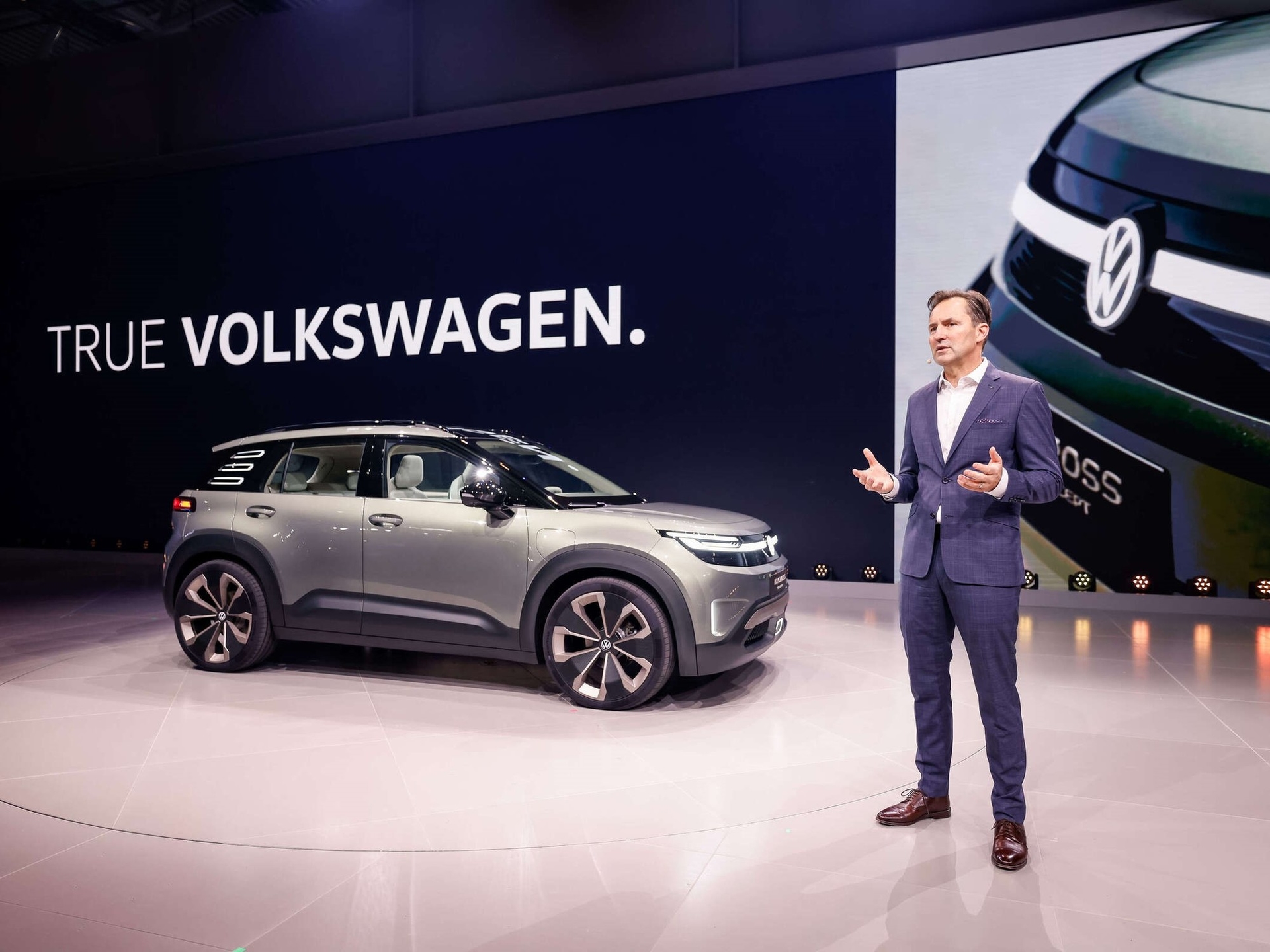
The Volkswagen Group opened the show at the Munich Motor Show, as the day before the doors opened, it began showcasing its strategy focused on compact, affordable cars to the press. Of course, all of them electric.
The German company corrected a poor naming strategy, in which it had previously designated numbers to identify models when they had very powerful names such as Golf , Polo or T-Cross.
 The new Audi Q3 is expected to arrive in Argentina next year. Photo: EFE
Thus, the electric vehicles originally shown as the ID.2 will be called the ID. Polo , and the ID.3 will likely be the ID. Golf. The ID. T-Cross will be launched with that name, and the smallest of the bunch could be called the ID. Up .
The most notable new feature was the ID.Cross, a prototype that previews the fully electric T-Cross designed for Europe. With classic SUV styling, this prototype measures 4,161 mm long, 1,839 mm wide, 1,588 mm high, and has a wheelbase of 2,601 mm.
It has an electric motor that delivers 211 horsepower, and its battery pack is estimated to provide a certified range of 420 kilometers . It will go on sale in the European summer of 2026.
 BMW iX3, the German brand's new electric SUV. Photo: Xinhua
Before that, the ID. Polo family, the German brand's compact model, will be launched. It will feature a conventional version and a sporty one, bearing the magical GTI acronym. Both models were shown in Munich, but with colorful camouflage. The range will start at 25,000 euros.
And the one that will complete VW's low-end electric car lineup will be the smallest and cheapest, and for now is known only by its prototype name, the ID.Every1. Its launch is scheduled for 2027 and will have a starting price of €20,000 in Europe.
Although none of these models will go to our region, at least for now, the German sample served to confirm that future hybrid models that are manufactured in Mercosur They will use a production platform currently used in Europe.
 New Mercedes-Benz GLC.
Audi presented the new generation of the Q3 Sportback , a model that should arrive in Argentina next year, and showed the Concept C prototype, a monolithic concept, inspired by the TT and that shows the future of the brand's design.
Porsche , for its part, launched the 911 Turbo S, the most powerful 911 ever: thanks to its 3.6-liter six-cylinder engine and hybrid system, it delivers 711 horsepower and goes from 0 to 100 km/h in 2.5 seconds. At the same time, it introduced an induction charger for its electric vehicles.
For BMW, it marked the debut of the iX3, an electric midsize SUV that represents the first in a new styling language that will shape the brand's future models. It also included a new information system with a large display below the windshield that complements the instrument panel.
 New Renault Clio.
Mercedes-Benz , with probably the most impressive stand at the entire show, showed off the new GLC, also in a 100% electric version and debuting a unique full LED light grille.
Among the non-German European companies, Renault stood out, launching the sixth generation of the Clio, its best-selling model in the Old Continent. It will be launched with two gasoline engine options (one of them prepared as standard for gas operation) and a hybrid that promises a fuel consumption of 3.9 L/100 km.
In that sense, Ford also introduced a version of the Ranger pickup with a plug-in hybrid system, although in this case with a sporty style and loaded with accessories.
 Ford Ranger plug-in hybrid.
The Chinese presence at the Munich trade fair was overwhelming, especially in the business sector, where the main focus is on the industry. There were more than 10 car brand stands, but the number of stands for developers of electrical systems, software, batteries, and various types of services was significantly increased.
On the automaker side, BYD debuted the SEAL 6 DM-i in Germany, a plug-in hybrid family car that offers a range of 1,500 kilometers. "In the next year or two, our plug-in hybrids will dominate sales" in Europe, said Stella Li, the brand's executive vice president.
The other new product was Leapmotors , the Chinese brand with which Stellantis aims to expand its electric vehicle business and which will soon be available in the Argentine market. In Munich, it presented the B05, a midsize car apparently destined for production in Spain.
 Leapmotor, the Chinese car brand that Stellantis will bring to the country. Photo: Bloomberg.
But there were also Xpeng, Gac, Changan, Aito, Dongfeng and Bao, all Chinese companies looking to expand their presence in Europe as part of their global expansion.


Clarin